Signs of Natural Crystal Inclusions to Look For
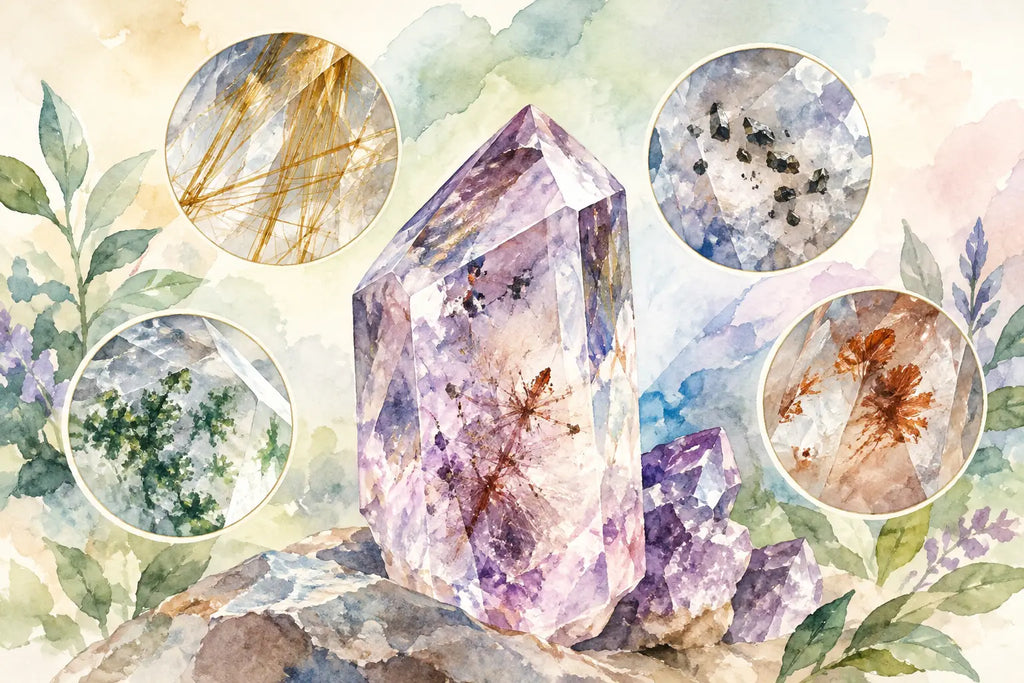
A clear quartz point with a tiny rainbow, a garden of mossy minerals, or a threadlike needle suspended inside can stop you in your tracks. These details are often among the most beautiful signs of natural crystal inclusions, but they are more than pretty features. They are traces of the conditions a mineral experienced while forming deep within the Earth.
For collectors, inclusions can make a piece feel especially personal. No two internal landscapes develop in precisely the same way. Still, inclusions should be understood with care: they can support a crystal’s natural story, but they are not a standalone guarantee of authenticity. A thoughtful look at the whole specimen - its growth, finish, color, source, and internal features - offers the clearest picture.
What Crystal Inclusions Really Are
An inclusion is material enclosed within a crystal as it grows, or a feature created by changes during and after its formation. It may be another mineral, a pocket of liquid or gas, a healed internal fracture, or a delicate pattern caused by shifts in temperature, pressure, and chemistry.
Think of an inclusion as a small record held inside the stone. Quartz can form around chlorite, hematite, rutile, tourmaline, or amphibole. Fluorite may show dramatic color zoning. Emerald often contains a complex network of internal features that gemologists call a "jardin," French for garden. These characteristics do not make a crystal lesser. In many mineral specimens, they are exactly what makes it memorable.
A perfectly transparent crystal has its own quiet appeal. But a piece with natural internal character can offer a different kind of beauty: evidence of time, movement, and an origin that cannot be duplicated by a factory mold.
Signs of Natural Crystal Inclusions
They follow the crystal’s internal growth story
Natural inclusions usually feel integrated with the crystal rather than simply placed inside it. Look for patterns that align with growth zones, facets, or internal planes. A veil may sweep through a quartz point in a soft diagonal; a mineral inclusion may appear to emerge from a deeper layer; fine needles may cluster in directions that reflect the host crystal’s structure.
This does not mean every natural inclusion is neat or symmetrical. Nature is wonderfully irregular. What matters is that the feature has a believable relationship to the crystal around it, instead of looking like a flat image, an isolated fleck, or a sharply artificial insert.
Their shapes are irregular, layered, or three-dimensional
Under natural light, genuine inclusions often reveal depth. Turn the crystal slowly. A cloud may shift in appearance as you change the angle. A mineral cluster may sit at several depths, while a healed fracture can catch light in fine layers.
This dimensional quality is especially helpful when looking at pieces with mossy, scenic, or garden-like interiors. In natural included quartz, the material often has uneven edges, varied density, and a sense of movement. A printed or surface-applied effect, by comparison, may remain visually flat from every direction.
You may see mineral companions inside the host crystal
Some of the most sought-after specimens contain recognizable mineral inclusions. Rutile can appear as golden, coppery, silver, or reddish needles in quartz. Tourmaline may form dark rods or sprays. Chlorite can create green phantoms, wisps, or landscape-like scenes. Hematite may show as red, rust, metallic gray, or glittering flecks.
The exact look depends on the minerals involved and the conditions in which they formed. A natural inclusion does not need to be dramatic to be meaningful. Sometimes the most compelling detail is a single tiny needle or a soft veil only visible in sunlight.
Fluid, gas, and rainbow features often have a natural softness
Fluid inclusions are tiny pockets that can contain water, gas, or both. In some crystals, they appear as minute bubbles, wisps, or small moving forms under magnification. Not every visible bubble is proof of a natural crystal - manufactured glass can contain bubbles too - but natural fluid inclusions tend to occur within a broader pattern of believable growth and mineral character.
Rainbows deserve a similar note of care. Many natural rainbows occur when light meets an internal fracture that healed or remained within the crystal during its geological journey. They can be breathtaking, especially in clear quartz. Yet rainbow flashes alone do not confirm a crystal is untreated, because fractures can also be enhanced or filled. Look beyond the flash to see whether the fracture appears naturally integrated and whether the seller clearly represents the piece.
Color zoning is usually nuanced rather than uniform
Natural crystals often show shifts in color that are uneven, layered, or concentrated along growth zones. Amethyst may move from pale lavender to rich violet. Fluorite can hold bands of green, purple, blue, or clear material. Tourmaline may transition through multiple hues within one crystal.
Natural color zoning rarely looks like a single hard stripe painted across the surface. That said, some natural minerals do have crisp color boundaries, so this is another place where context matters. If a color seems unusually neon, concentrated in cracks, or pooled around drill holes and edges, it is reasonable to ask whether the stone has been dyed or treated.
Natural Inclusions vs. Chips, Cracks, and Treatments
An inclusion is not the same as damage. A chip or surface-reaching crack changes the physical condition of a crystal. An internal veil or healed fracture may be completely stable and part of the specimen’s natural character.
Run your eye and, if appropriate, a clean fingertip gently over the area. If you can feel a sharp break, roughness, or opening, it may be surface damage rather than an internal inclusion. On polished pieces, a fracture that reaches the exterior may also affect durability, particularly if the crystal will be worn or handled frequently.
Treatments are not automatically bad. Heat treatment, irradiation, stabilization, and fracture filling are used in the gem and mineral trade for different reasons. The meaningful distinction is disclosure. A treated piece can still be lovely and worth owning when it is honestly represented. For a collector who wants a natural, untreated specimen, transparency makes it possible to choose with confidence.
Be especially cautious of crystals with intensely saturated color collected in surface cracks, unusually uniform glitter, or internal effects that look identical across many supposedly unique pieces. These details are not final verdicts on their own. They are invitations to ask better questions.
How to Examine a Crystal Before You Choose It
Start in indirect daylight or under a neutral white light. Rotate the piece rather than judging it from one angle. Notice where an inclusion sits, whether it has depth, and how it interacts with the crystal’s growth lines and natural edges.
A simple jeweler’s loupe can be helpful, but it is not required for appreciation. With magnification, you may see tiny mineral crystals, layered veils, liquid pockets, or fine textures that were invisible at first glance. A loupe can also reveal whether a feature sits beneath the surface or is simply a scratch on the polish.
Ask the seller about the mineral identification, locality when known, whether the crystal has been treated, and how it was sourced. A responsible seller should welcome thoughtful questions, even when a precise mine location is unavailable. Minerals pass through complex supply chains, and honest sourcing sometimes means sharing what is known without making claims that cannot be verified.
At Bellissima Crystals, we believe the most meaningful pieces are chosen with both wonder and discernment. A clear description, careful photography, and a willingness to discuss a specimen’s natural features help turn a beautiful purchase into a more connected collecting experience.
When an Expert Opinion Is Worth Seeking
For everyday collecting, your eye, trusted sourcing, and a few well-asked questions go a long way. But if you are considering a high-value gem, an unusually rare mineral, or a piece being sold with strong claims of being untreated or exceptionally scarce, professional identification may be worthwhile.
Gemologists and qualified mineral experts can use magnification, microscopy, refractive testing, and other methods that go far beyond a visual check at home. Their assessment is particularly valuable for faceted gemstones, where inclusions can influence both authenticity and value. For a decorative crystal tower or raw specimen, the goal is often less about certification and more about finding a piece whose story feels honestly represented.
A natural inclusion does not need to look perfect to be beautiful. Let the tiny trails, mineral gardens, soft clouds, and hidden rainbows invite a closer look. The right crystal is often the one that keeps revealing something new each time you hold it to the light.